
Active Warrants in Sarasota County
Warrants in Sarasota County are issued by judges, not by police. Under Florida Statutes § 901.02, a judge may issue an arrest warrant when there is probable cause from a sworn complaint or other lawful basis. Law enforcement then carries it out. A judge can also issue a bench warrant or capias when a person fails to appear, breaks a court order, or does not comply with probation or payment terms. So the court starts the warrant, and the Sheriff and other agencies execute it.
Warrant data shows up in more than one place. The Sheriff's Arrests & Inmate Search page can show people arrested on warrants. The Clerk's ClerkNet court system can show capias or warrant entries on a case docket, plus failure-to-appear events and any recall or quash orders. How fast a warrant appears in public data depends on the agency and the case. The Sheriff page is not a final-disposition record, so it should never be treated as the only warrant source.
There is also no single master list of every active warrant open to the public. Some warrant detail lives only inside a case docket. Some never reaches public view at all. That is why a real Sarasota County warrant search means checking both the Sheriff data and the court record, then reading the docket entries closely. The word "active" matters here. A warrant stays active until a judge recalls or quashes it, the person is arrested, or the court marks it satisfied. Until one of those things happens, the order remains in force, and an officer can act on it.
Types of Warrants in Sarasota County
Florida courts issue several kinds of warrants. They look similar but serve different purposes. Knowing the difference helps you read a docket entry the right way.
- Arrest warrant - issued on probable cause under § 901.02 to take a named person into custody for an alleged crime.
- Bench warrant - ordered by a judge from the bench, often when someone disobeys a court order.
- Search warrant - authorizes law enforcement to search a place or item for evidence.
- Capias / failure-to-appear - a court order to arrest a person who missed a required court date or failed to comply.
How to Search Sarasota County Warrants
Start with official sources. The Sheriff's Arrests & Inmate Search tool covers people booked on warrants. The Clerk's ClerkNet system covers court dockets, where capias and warrant entries can appear on a case. Use the two together. One shows custody, the other shows the court record.
- Search the Sheriff arrest and inmate tool by name to see if the person was arrested on a warrant.
- If you know the criminal case number, open it in ClerkNet and read the docket for any capias or warrant entry.
- Check the docket for a recall, quash, or satisfied entry that shows the warrant has been resolved.
Sarasota County Warrant Search Fields
The fields you use depend on which tool you open. The Sheriff app searches arrest and inmate data, while ClerkNet searches court party names and case numbers. The table below lists the practical search fields drawn from the official portals.
| Field Label | Type | Required | Notes |
|---|---|---|---|
| Name | Text | No | Search the Sheriff arrest app or a ClerkNet party name. |
| Case Number | Text | No | Search ClerkNet for warrant or capias docket entries. |
| Booking Number | Text | No | For a person already arrested and in the jail app. |
| Charge / Agency | Filter | No | Narrows results where the Sheriff app exposes it. |
| Search | Button | Yes | Runs the selected portal query. |
What a Sarasota County Warrant Record Shows
When a warrant or capias is public, the record holds a set of basic facts. Some fields only appear once the warrant has been executed. The inventory below reflects the warrant-record fields found in the research, drawn from court dockets and arrest data.
| Field | What It Shows |
|---|---|
| Person Name | The named subject of the warrant. |
| Case or Warrant Number | The court case number or warrant number where public. |
| Charge / Offense | The alleged offense behind the warrant. |
| Issuing Court or Agency | The court or agency that issued the warrant. |
| Date Issued | When the warrant was ordered. |
| Bond Amount | The bond set, or a no-bond status. |
| Arresting Agency | The agency that executed the warrant, if served. |
| Resolution Entry | A recall, quash, or satisfied entry once resolved. |
| Custody Status | Whether the person is in custody after arrest. |
What to Do If You Have an Outstanding Warrant
An outstanding warrant does not go away on its own. Ignoring it can lead to an arrest at any time. The smart move is to verify the warrant through official sources first, then follow the court's instructions. Do not rely on unofficial warrant websites, which can be wrong or out of date. If a criminal case number is known, the ClerkNet docket can show the warrant status and any hearing orders.
Bond may apply once a person is taken into custody, depending on the charge and any court order. Payment alone does not always clear a warrant. The court or Clerk must confirm a recall before you treat it as resolved. People who cannot afford a lawyer can ask the court about indigent status and the Public Defender for the Twelfth Judicial Circuit.
- Verify the warrant through official sheriff and court sources.
- Check the ClerkNet docket if you know the case number.
- Talk to a lawyer or the Public Defender if you qualify.
- Follow the court's instructions for surrender, bond, or a hearing.
- Confirm the docket later shows the warrant recalled, quashed, or satisfied.
Important: Talk to a lawyer before you turn yourself in, because counsel can often arrange a surrender, bond, or hearing on better terms.
Bond and Capias in Sarasota County
A capias is a common kind of warrant in Florida. It is a court order to arrest, often issued for a missed court date or a failure to comply. When the docket lists a capias, it usually shows the linked case and any bond. Bond is money or conditions that secure release before trial. Some warrants are issued with a set bond. Others are marked no-bond, which means a judge must rule before release.
After an arrest on a warrant, a defendant generally sees a judge promptly for first appearance under Florida criminal procedure. That hearing reviews probable cause and bond. To follow the underlying charge, pull the case in Sarasota County court records. For the broader charge picture, see criminal records.
Bench warrants and capias warrants differ from a fresh arrest warrant in one key way. They grow out of an existing case. A person who skips a hearing, ignores a payment plan, or breaks probation can trigger one. The docket then logs the order. Because the case already exists, the ClerkNet record is often the clearest path to the warrant. The Sarasota Clerk of the Circuit Court and County Comptroller maintains those court records and posts them through ClerkNet for public search. Reading the docket in order shows when the warrant was issued and whether anything has cleared it since.
Restricted Sarasota County Warrant Records
Not every warrant is public. Some are sealed by court order or by rule. Juvenile matters are restricted under Florida law. Active investigations may stay confidential until an arrest is made, so a search warrant tied to an open case may not appear in public data. Federal warrants are handled in the federal system, separate from Sarasota County and state courts.
Out-of-county and out-of-agency warrants add another wrinkle. Several area agencies bring people to the Sarasota County Jail, so a warrant behind an arrest may come from another agency. Reports for those arrests should be requested from the arresting agency. For people already booked, the Sarasota County inmate records page is the right tool.
The arrest-warrant statute is posted in full by the Florida Senate, which sets out when a judge may issue a warrant. We pull this lead-in from the official posting of Florida Statutes § 901.02.
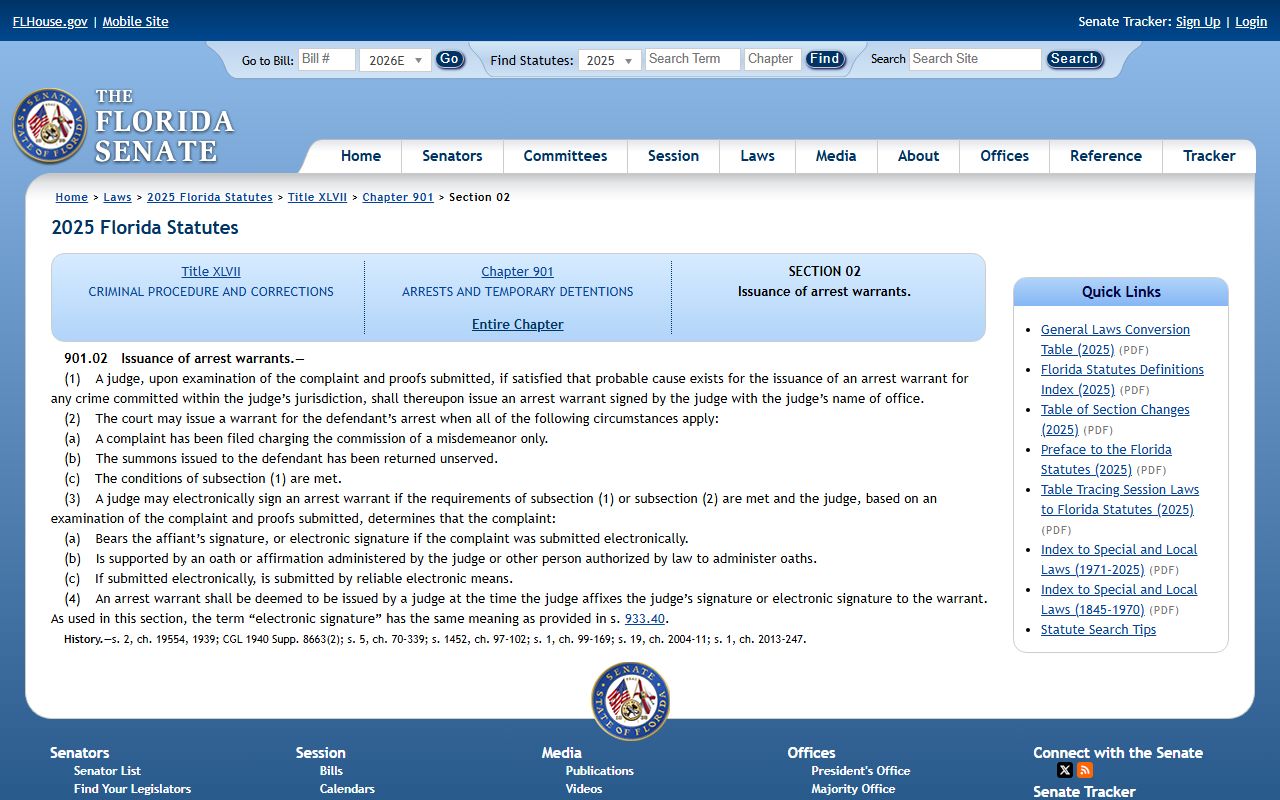
The statute ties warrant issuance to probable cause, which explains why a judge, not an officer, signs off on every Sarasota County arrest warrant.
Note: Sealed warrants and active-investigation material will not appear in a public Sarasota County warrant search, so an empty result does not always mean no warrant exists.