
Florida Public Records Act
The Florida Public Records Act lives in Chapter 119, Florida Statutes. It sets a policy of open government and gives anyone the right to inspect and copy public records unless a clear exemption applies. The right does not depend on who you are or why you ask. Sarasota County agencies, the Clerk, and the Sheriff all fall under this framework for their records. Court records add a second layer of judicial-branch rules, mainly Rule 2.420.
The official Chapter 119 statute page spells out the policy and the obligations agencies owe to requesters.
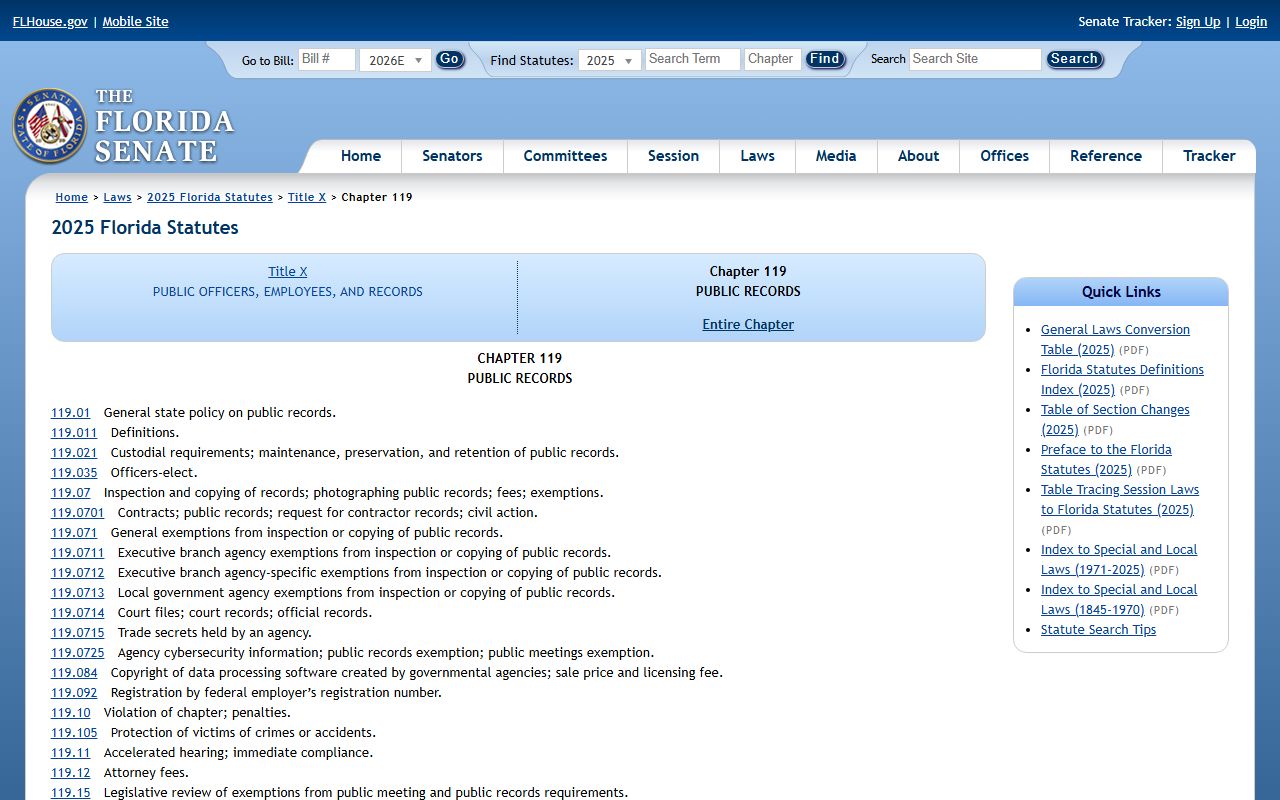
Chapter 119 is the legal backbone for every Sarasota County public records request to a county agency. The mechanics of inspection and copying come from a companion section covered next.
Inspection and Copying Rights in Sarasota County
The duty to let you look and copy comes from Florida Statutes § 119.07. It requires the custodian of a record to permit inspection and copying at reasonable times and under reasonable conditions, unless an exemption applies. The same section governs response mechanics and the fees an agency may charge. So a Sarasota County public records request runs on a clear legal standard, not on agency goodwill.
The inspection and copying statute is the rule a custodian must follow when you ask to see a record.
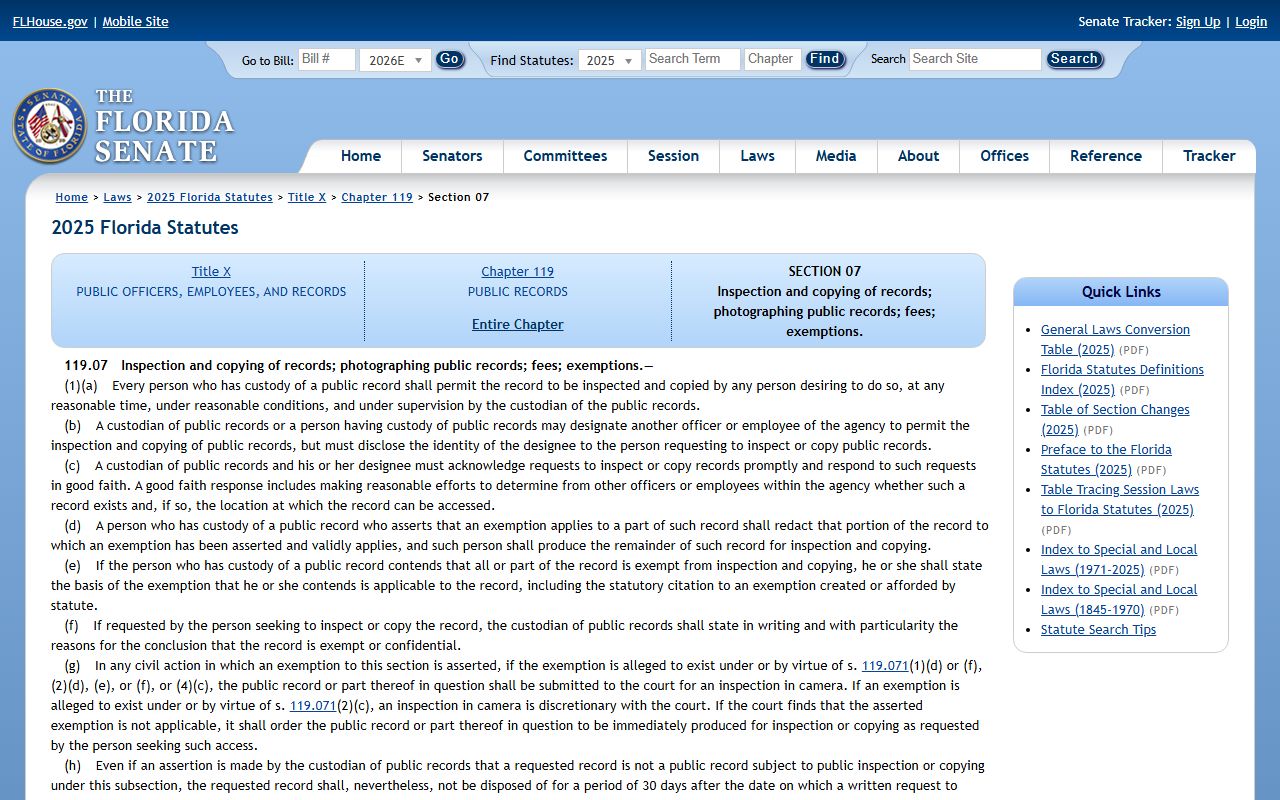
If a custodian withholds part of a record, the section also frames how the agency must respond, which sets up the exemptions and appeal steps further down.
What the Sarasota County Clerk Maintains
The Sarasota Clerk of the Circuit Court and County Comptroller keeps far more than court files. Beyond cases, the Clerk records official documents and maintains marriage and probate records. Official Records, which hold deeds, mortgages, and liens, are searched in a separate portal from the ClerkNet court system. The list below covers the main categories the Clerk maintains.
- Court records: civil, criminal, family, probate, and traffic cases through ClerkNet.
- Official Records: deeds, mortgages, liens, plats, and satisfactions.
- Marriage records and recorded marriage instruments.
- Probate filings, including estate and guardianship records.
- County comptroller and finance records.
For recorded land and marriage instruments, use the Official Records page rather than the court search. The two systems are not interchangeable.
How to File a Public Records Request in Sarasota County
A public records request can be simple. Florida law does not require a special form or a stated reason. You identify the office, describe the records clearly, and submit by the agency's accepted channel. The Clerk handles its own records at the Clerk's public records request page; the Sheriff handles its records at the Sheriff's public records request page. The steps below keep a request moving.
- Identify the right office: the Clerk for court and official records, the Sheriff for arrest and jail records.
- Describe the records you want as precisely as you can, with names, dates, or case numbers.
- Submit by the agency's channel: online portal, email, mail, or in person.
- Wait for the response and any cost estimate before large jobs are processed.
- Pay any lawful fees, then receive the records by your chosen delivery method.
Sheriff Records Requests in Sarasota County
The Sarasota County Sheriff's Office keeps arrest, jail, and incident records under the same Chapter 119 framework. The Sheriff's Records Section answers requests Monday through Friday, 8 a.m. to 5 p.m. except holidays, at 941-861-4025. One Sarasota-specific catch matters: several area agencies bring arrestees to the county jail, and the Sheriff says arrest reports should be requested from the records section of the arresting agency. So if another agency made the arrest, that agency holds the report. For more on custody and arrest data, see criminal records and inmate records.
Sarasota County Sheriff's Office, Records Section
941-861-4025
Mon-Fri, 8 a.m. to 5 p.m. except holidays
Public Records Request Form Fields
Even though no form is required by law, a clear request beats a vague one. Agencies move faster when the request names the records, the dates, and a way to reach you with a cost estimate. The fields below cover what a strong Sarasota County public records request includes.
| Field | Required | Notes |
|---|---|---|
| Requester Name | Yes | Florida does not require a reason, but a contact name speeds delivery. |
| Description of Records | Yes | Be specific: names, case numbers, document types. |
| Date Range | No | Narrows the search and lowers labor cost. |
| Format Preference | No | Paper, electronic, or certified copy. |
| Contact Method | Yes | Email or phone for a cost estimate and response. |
Sarasota County Public Records Response Timelines
Florida law does not set a fixed deadline in days. Instead, an agency must acknowledge a request and produce records within a reasonable time, allowing only the limited delay needed to retrieve records and review for exemptions. A simple request should be quick. A broad request that spans many records, archives, or redactions takes longer. If a record is withheld, the custodian must state the legal basis for the exemption.
Public Records Fees in Sarasota County
Chapter 119 allows actual duplication costs, and for jobs that need extensive staff or technology, a special service charge based on the actual labor and technology cost. Court and clerk fees may also be set by statute and the Clerk fee schedule. The table points to those sources rather than naming a figure, since amounts vary by record and office.
| Item | Amount |
|---|---|
| Per page copy | See current agency fee schedule |
| Special service charge (extensive labor) | Based on actual labor and technology cost |
| Certified copy | See current Clerk fee schedule |
| Electronic format | See current agency fee schedule |
The Clerk publishes current amounts at sarasotaclerk.com. A special service charge applies only when the request requires extensive use of staff time or technology.
Electronic Access to Sarasota County Records
Two statutes shape online access to Sarasota records. Florida Statutes § 28.2221 governs electronic access to official records, and its subsection (5)(a) limits remote images in family, juvenile, and probate cases for general public users. Florida Statutes § 28.22205 covers electronic filing and access functions that the Clerk runs.
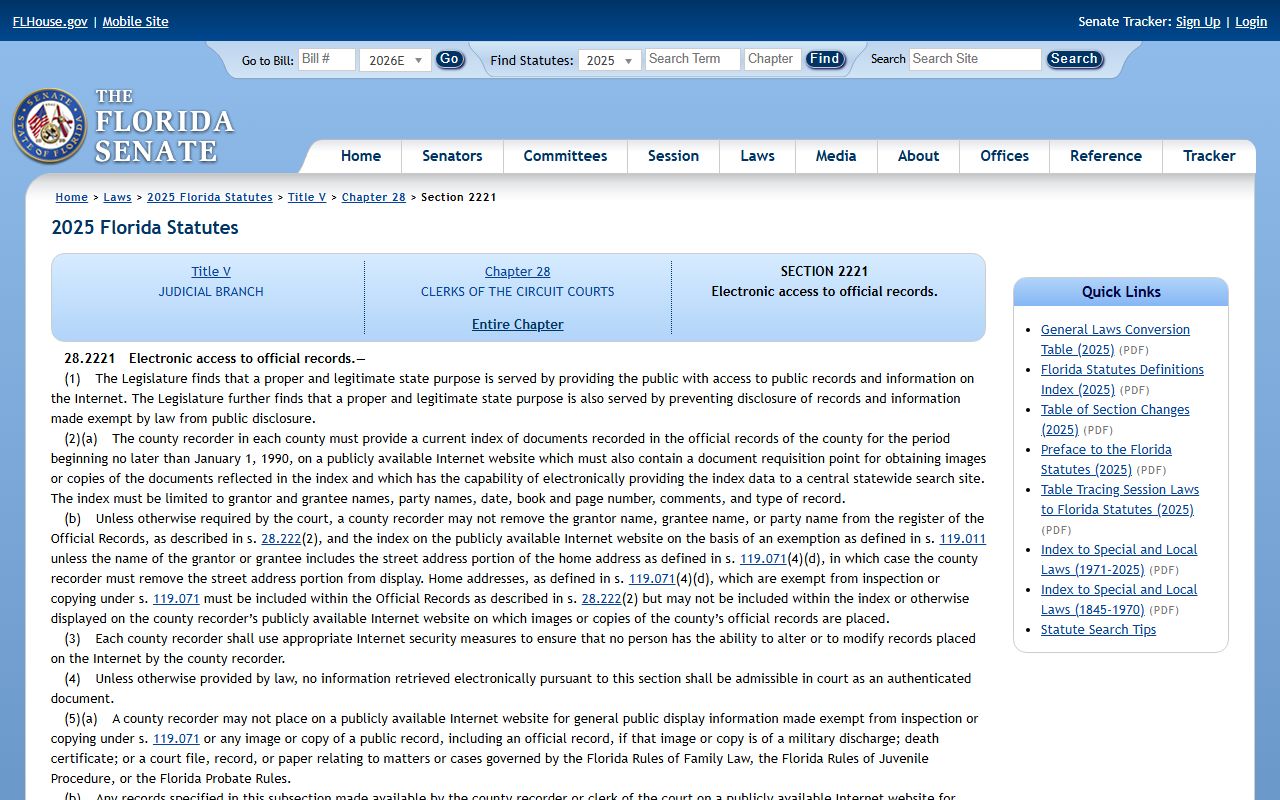
That electronic-access statute is why a case can be public online while certain images are not. The companion filing statute appears below.
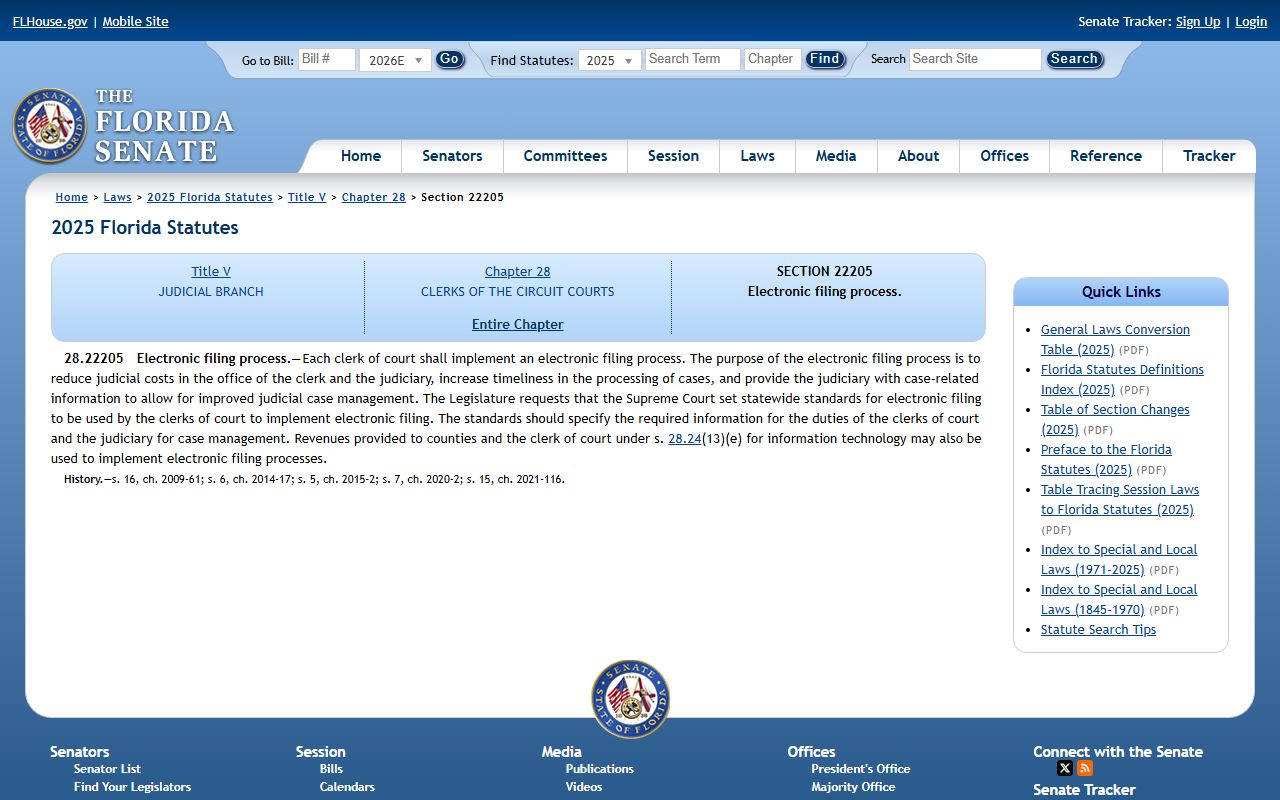
Together these sections set the rules for the Clerk's online systems, including ClerkNet and Official Records search.
Records That Are Exempt
Open access has limits. Sealed and expunged records, juvenile delinquency and dependency files, adoption records, and many mental-health and substance-abuse records are exempt or confidential. Protected victim information, certain financial identifiers, and Social Security numbers are redacted. Family and probate document images are restricted for general public remote access. Rule 2.420 and specific statutes govern which categories close and how.
Note: When an agency withholds a record, it must identify the specific statutory exemption that justifies keeping the record from public view.
If Your Request Is Denied
A denial is not the end. For a county-agency denial under Chapter 119, you can ask the custodian to name the legal exemption in writing, then seek court enforcement if the answer is unsatisfactory. For court records, Rule 2.420 procedures apply, and an affected person may move for access or contest a confidentiality or sealing decision. The Florida Attorney General publishes open-government resources and opinions, but courts decide contested access disputes. Keep a written record of the request and the response in case you need to enforce it.