
Arrest Records in Sarasota County
Arrest records in Sarasota County are made by law enforcement. The Sarasota County Sheriff's Office runs the county jail and books people in. City police, the Florida Highway Patrol, and other area agencies also bring people to the jail. So a single arrest record can trace back to more than one agency. The record itself starts at booking. It lists the person's name, the date, the charges from the arrest, bond, and a booking number.
It helps to know what an arrest record is not. An arrest record is not proof of guilt. It is also not the full court file. Once the State files charges, a criminal case opens with the Clerk and the court takes over. That case file holds the pleadings, motions, plea, and the final outcome. The arrest is just the first event. For the full case history, the Sarasota County court records page covers the court side. The Sheriff's own page warns that its data does not show the final disposition of a case.
How to Search Sarasota County Arrest Records
The Sheriff's Arrests & Inmate Search page is the main local tool for recent bookings. It is free and open to the public. For the court side of a charge, use the Clerk's ClerkNet system. Anonymous access to ClerkNet is also free. The Sheriff covers the arrest. ClerkNet covers the case that follows.
- Open the Sheriff's Arrests & Inmate Search page and read the disclaimer about arrest data.
- Enter a name or booking number to find a recent arrest or current inmate.
- Review the result for charges, booking date, agency, and bond.
- To track the case in court, switch to ClerkNet and search the party name or case number.
For a statewide criminal history, the Florida Department of Law Enforcement runs a separate paid service. Its criminal history record check pulls reported arrests and dispositions across Florida, not just Sarasota County. That is a different tool from a local arrest search and from a court file search.
The Sheriff page is the right first stop for arrests by Sarasota County agencies. Reports made by another agency can be requested from that arresting agency. We capture this lead-in from the Sheriff's official Arrests & Inmate Search page.
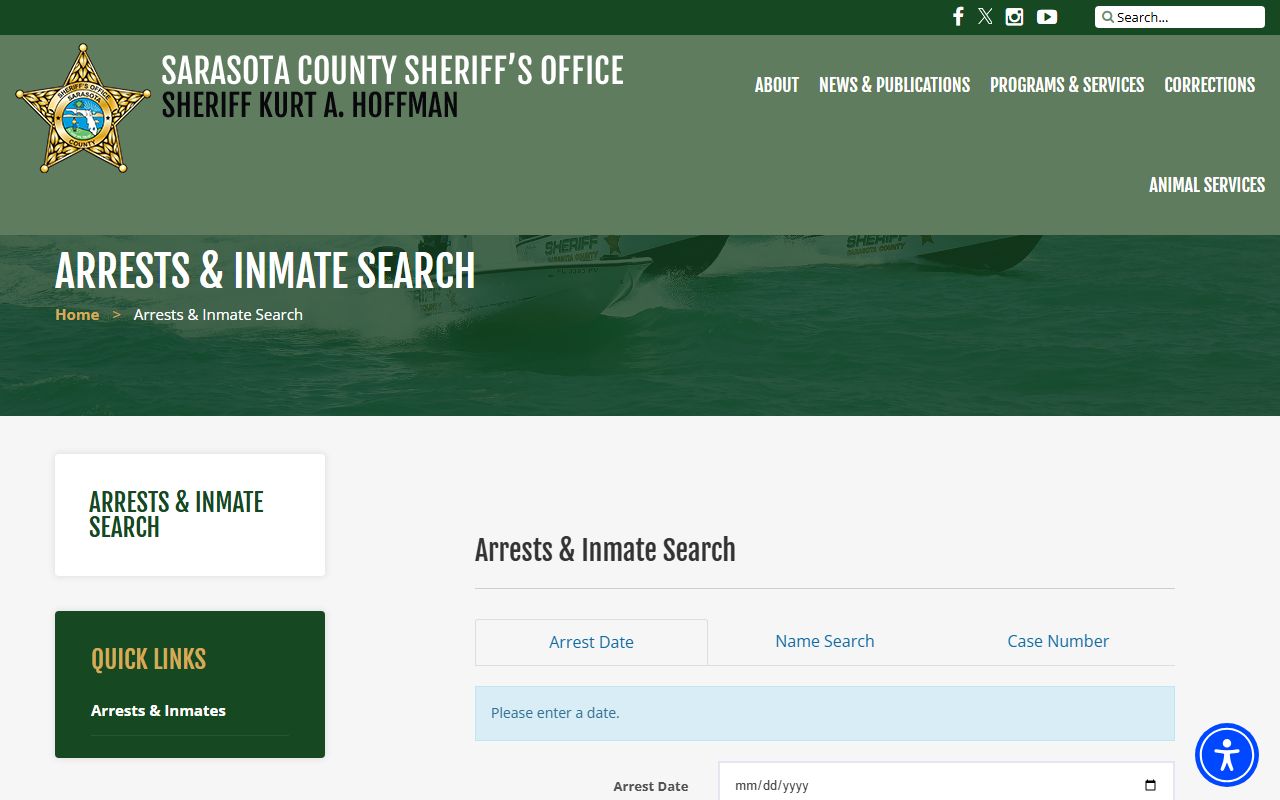
The page embeds an arrest and inmate application that returns recent bookings, so it is the official local source for current arrest and custody data.
Arrest Records vs. Criminal Court Records
An arrest record and a criminal court record cover different stages. The arrest record is born at booking, run by the Sheriff. The court record is born when the State Attorney files a charge with the Clerk. One is a snapshot of a single day. The other is the running story of the case.
| Arrest Record | Criminal Court Record | |
|---|---|---|
| Source | Sheriff / Police | Court Clerk |
| Created When | Booking | Charges filed |
| Contents | Booking info, charges, mugshot | Pleadings, motions, disposition |
Felony cases and misdemeanor cases also split between two courts. Felonies are prosecuted in the Circuit Court. Misdemeanors and criminal traffic charges land in County Court. Both are searched in ClerkNet, but the division code on the case number tells you which court holds it. The Circuit Court handles the most serious charges; the County Court handles the rest.
Charges vs. Convictions
Being charged is not the same as being convicted. A charge is an accusation. The State files it based on probable cause. A conviction comes only after a plea of guilty or a verdict, and the legal bar there is much higher. Many charges never end in a conviction. Cases get dropped, dismissed, or reduced. This is why an arrest listing alone tells you very little about the final outcome.
| Charge | Conviction | |
|---|---|---|
| Stage | Accusation | Verdict or plea |
| Burden of Proof | Probable cause | Beyond reasonable doubt |
| Public Record | Yes | Yes |
The case docket in ClerkNet is where the outcome shows up. Look for the disposition line. It may read dismissed, nolle prosequi, adjudicated guilty, or withhold of adjudication. A sentence, probation terms, fines, and any bond detail also appear there. To read the full disposition history, pull the case in Sarasota County court records.
- Information
- The charging document the State Attorney files to start most criminal cases.
- Disposition
- The final outcome of a charge, such as dismissed, guilty, or acquitted.
- Adjudication withheld
- The court withholds a formal conviction, often with probation, in qualifying cases.
Sealed vs. Expunged Records
Florida law lets some people limit public access to a criminal record. Two paths exist: sealing and expunction. Sealing hides an eligible record from the public while keeping it intact for certain agencies. Expunction goes further and orders the physical record removed or destroyed. Both are court remedies, not automatic, and both have strict rules. They are governed by Florida Statutes § 943.0585 for expunction and Florida Statutes § 943.059 for sealing.
| Sealed | Expunged | |
|---|---|---|
| Visibility | Hidden from public | Destroyed / treated as never existed |
| Law Enforcement | Limited access | Very limited |
| Eligibility | Some qualifying dispositions under § 943.059 | Often where charges were dropped or not filed, under § 943.0585 |
The process usually starts with eligibility. A petitioner often must get a certificate of eligibility from the Florida Department of Law Enforcement, file a petition package in the proper court, serve the right agencies, and attend a hearing if one is set. Common reasons for denial include a disqualifying conviction, a prior sealing or expunction, an ineligible offense, or incomplete paperwork. If a judge grants the order, the Clerk and law enforcement then restrict access.
You can read the expunction statute directly through the Florida Senate's posting of Florida Statutes § 943.0585.
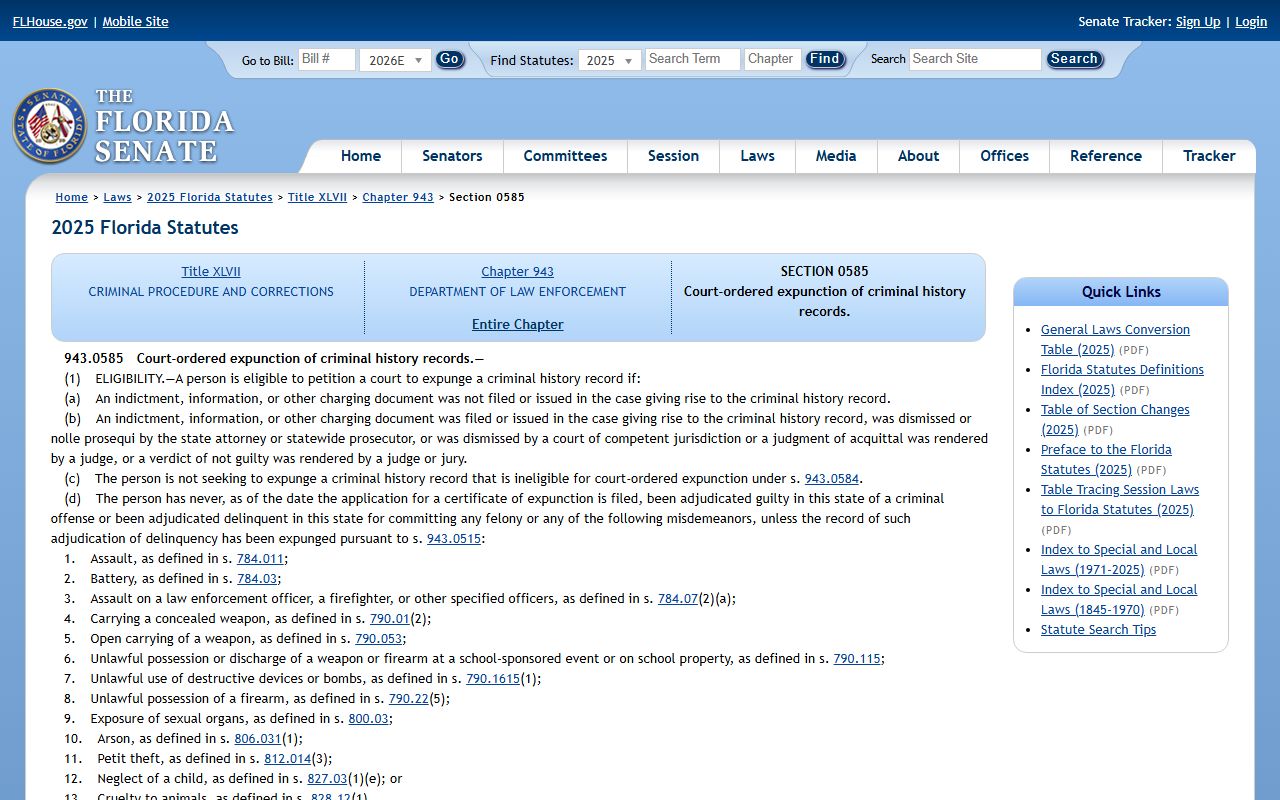
The statute lays out who qualifies and what an expunction order does, which is why eligibility should be checked before any petition is filed.
The sealing rules sit in a separate section. The Florida Senate also posts Florida Statutes § 943.059 in full.
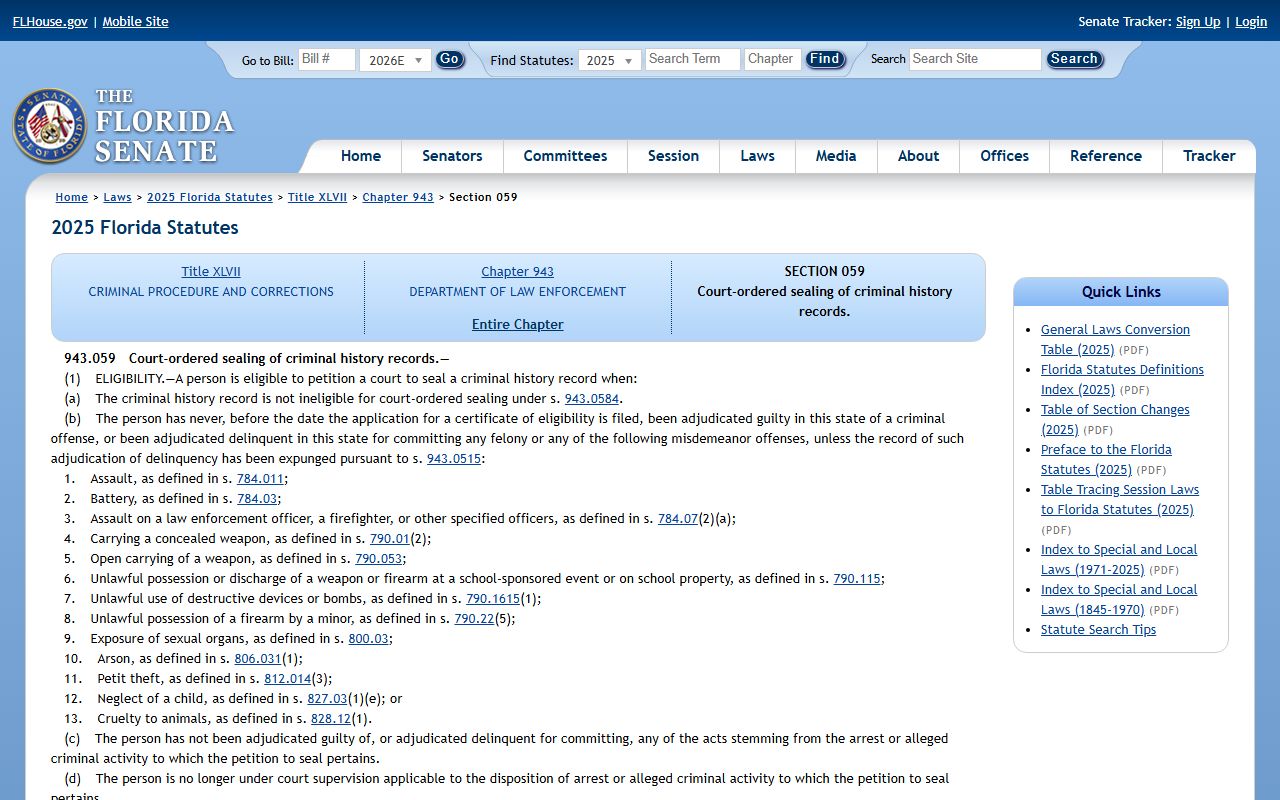
Sealing keeps the record from public view while still allowing access for limited official uses, so it differs from a full expunction.
Sarasota County Mugshots and Booking Photos
A booking photo, or mugshot, is taken during intake at the county jail. Where the Sheriff's arrest tool shows a photo, it comes from that booking. These images can be public as part of the arrest record. Still, a mugshot only marks an arrest. It says nothing about guilt or the case outcome. Treat it the same way you treat any arrest listing, as a starting point, not a verdict.
If a record is later sealed or expunged, public access to the related arrest data, including any photo, can be restricted. For the case result behind a booking photo, check the court file in Sarasota County court records rather than relying on the image alone.
Statewide Sarasota County Criminal Records
A local arrest search only covers Sarasota County bookings. For a fuller picture, Florida keeps a statewide criminal history. The Florida Department of Law Enforcement runs that system. Its criminal history record check service returns reported arrests and dispositions from agencies across the state. It is a paid request, and it is the official statewide source.
This is a different record from a court file. Florida's public-records framework sits in Chapter 119, Florida Statutes, and the inspection and copying rules are in Florida Statutes § 119.07. Court records carry their own access limits under court rules. So a statewide history, a local arrest record, and a court case file are three separate things, each with its own request path.
Sarasota County Background Check Considerations
People run criminal searches for many reasons. A landlord, an employer, or a person checking a date all want different things. There is a real legal line here. A formal background check used for hiring, housing, credit, or insurance must follow the federal Fair Credit Reporting Act and use a regulated agency. A casual public-records lookup is not that. Mixing the two can cause legal trouble.
Important: This is a private site and not a consumer reporting agency under the FCRA; do not use it for credit, hiring, housing, or insurance decisions.
State Attorney and Public Defender in Sarasota County
Florida uses the title State Attorney, not District Attorney. The Office of the State Attorney, Twelfth Judicial Circuit, prosecutes Sarasota County criminal cases. The circuit covers Sarasota, Manatee, and DeSoto Counties. The State Attorney decides what charges to file, handles plea talks, takes cases to trial, and runs victim and witness services. Its official site is the State Attorney for the Twelfth Judicial Circuit.
On the other side stands the Public Defender. The Public Defender for the Twelfth Judicial Circuit represents people who cannot afford a lawyer and qualify for court-appointed counsel in criminal and delinquency cases. A defendant applies for indigent status through court and clerk steps. If they qualify, the judge appoints the Public Defender or other counsel. The office does not handle ordinary civil matters.
We pull this lead-in from the official Public Defender for the Twelfth Judicial Circuit site.
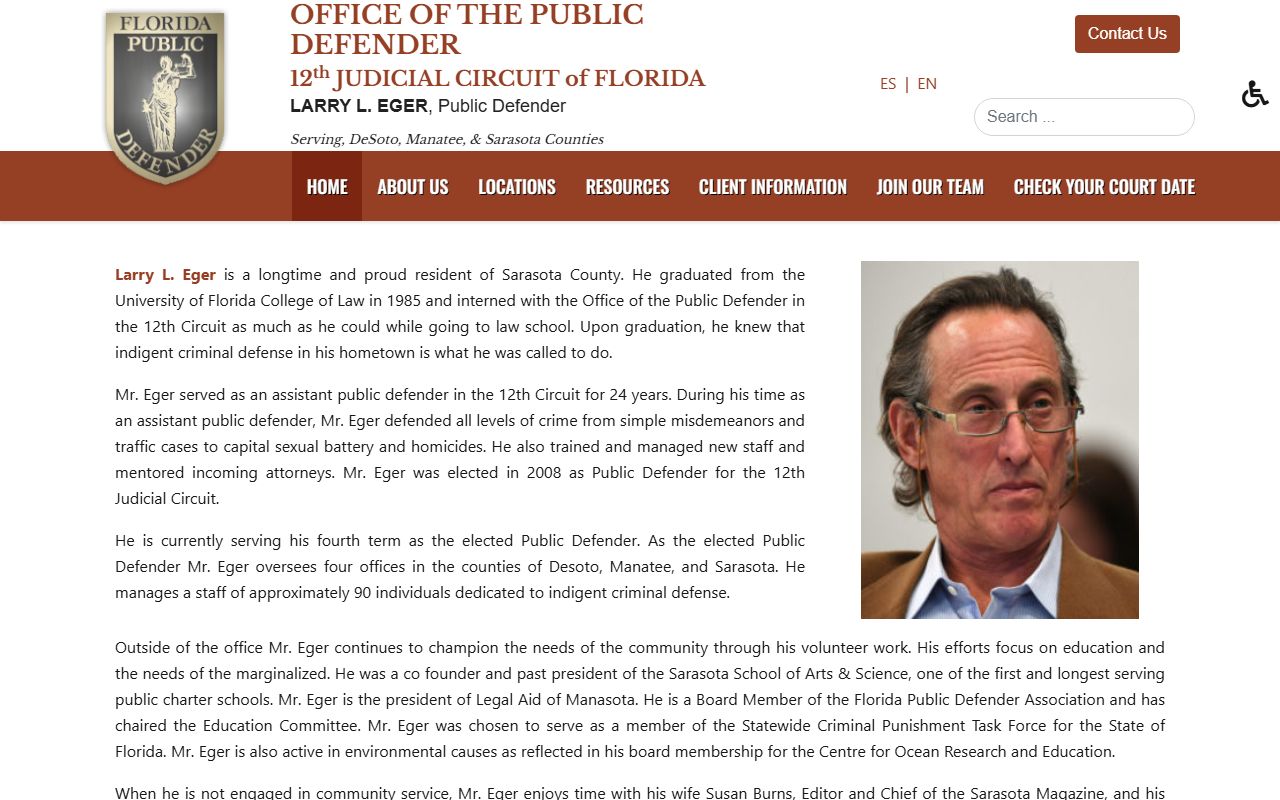
The office serves the same three-county circuit as the State Attorney, so both sides of a Sarasota County criminal case are organized at the circuit level.
Restricted Criminal Records in Sarasota County
Not every criminal record is open. Juvenile records are tightly limited under Florida law. Sealed and expunged records drop out of normal public view. Records made confidential by court order, or automatically confidential under court rules, are also off limits to the general public. ClerkNet itself excludes expunged, sealed, and rule-confidential records from anonymous access, and it cites Florida Supreme Court administrative orders for those limits.
- Juvenile delinquency records, restricted under Florida Statutes § 985.045.
- Sealed records, which need party or authorized status to view.
- Expunged records, removed from ordinary public access.
- Active investigation material that is not yet public.
- Protected victim information and personal identifiers.
For related searches, the Sarasota County warrant records page covers active warrants, and DUI and reckless-driving charges overlap with traffic court records. To find someone in custody right now, use the inmate records page.
Note: A case can exist in ClerkNet while certain document images stay hidden, so a missing image does not mean the case is missing.