
Sarasota County Jail Roster Overview
The Sarasota County Sheriff's Office runs the county jail and publishes an official Arrests & Inmate Search page. The Sheriff, Kurt A. Hoffman, provides this as a service to citizens, families, attorneys, law enforcement, and others. The page embeds a search application that returns recent bookings and current inmates. It is the official local tool for who is in custody. The roster is updated by the Sheriff's Office as bookings and releases happen.
The roster has limits. The Sheriff's own page warns that the data does not detail the final disposition of a criminal case. It also notes that several area agencies bring people to the Sarasota County Jail. So a booking may come from city police or another agency, not just sheriff deputies. The roster does not cover state prison inmates, federal inmates, or immigration holds. For state custody, use the Florida Department of Corrections. For federal custody, use the Bureau of Prisons. We pull this lead-in from the Sheriff's official homepage.
Think of the roster as a live snapshot of the jail, nothing more. It answers one question well: is this person in the Sarasota County Jail today, and on what booking. It does not answer whether the person is guilty, what plea was entered, or how the case closed. Those answers live in the court file. This split trips up many users. A person can sit on the roster for weeks while their case is still open in court. The roster reflects custody. The Clerk's record reflects the case. Reading both together gives the full story.
From the Sheriff's homepage, the arrests and inmate tools and the corrections pages are the official entry points for any Sarasota County inmate records search.
How to Use the Sarasota County Inmate Roster
The roster lives on the Sheriff's Arrests & Inmate Search page. It is free and open to the public. The steps below walk through a basic name search.
- Open the Sheriff's Arrests & Inmate Search page and read the disclaimer about arrest and inmate data.
- Enter a last name, full name, or booking number in the embedded search tool.
- Review the result rows for name, booking date, agency, charges, and bond.
- Open a result to see the inmate profile detail where the app exposes it.
A booking number is the strongest identifier if you have it. Common names return many results, so a date or booking number helps narrow them. If you only have a name, try the last name first, then add a first name to cut the list. Spelling matters. A small misspelling can hide a real match, so try variations if the first search comes up empty. We capture this lead-in from the Sheriff's official Arrests & Inmate Search page.
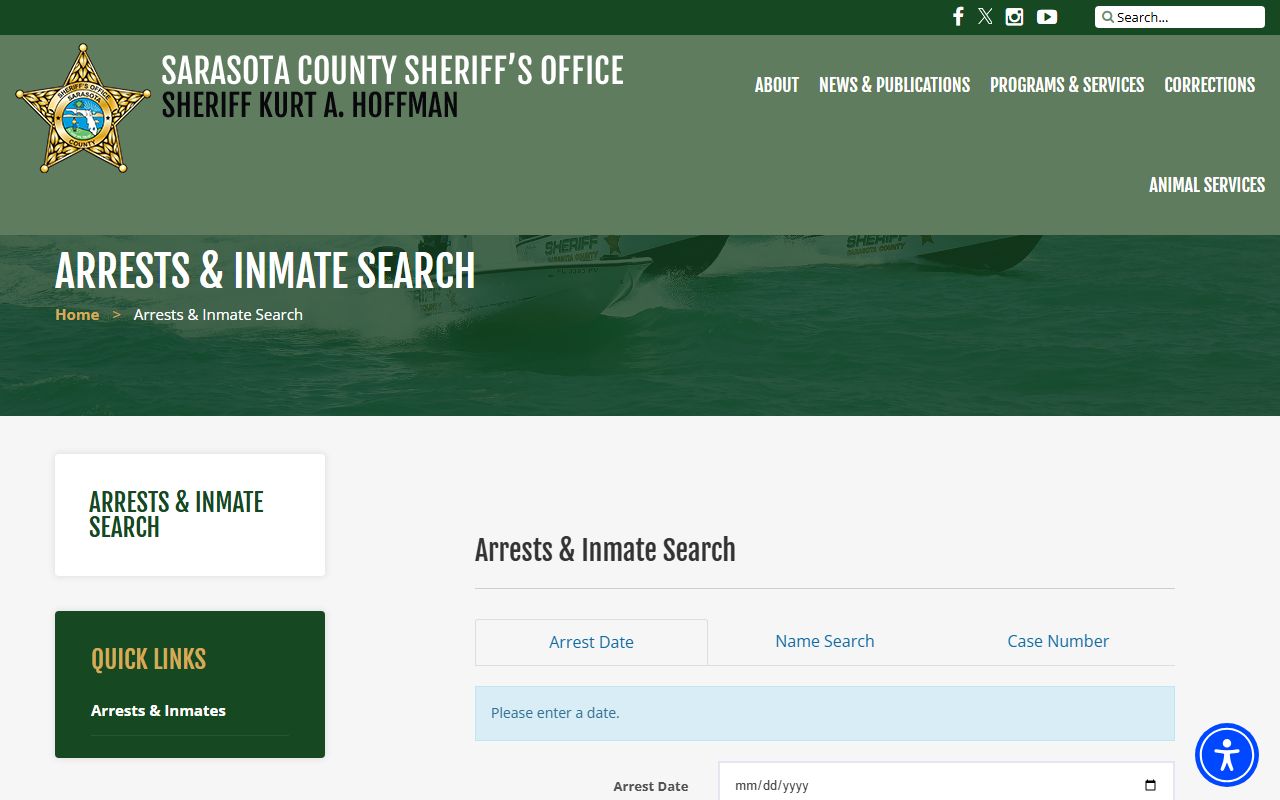
The embedded application returns recent bookings and current custody data, so it is the right first stop for a live roster lookup.
Sarasota County Roster Search Fields
The Sheriff's inmate tool accepts a small set of search fields. The table below lists those fields as found in the research. Exact options can vary as the Sheriff updates the application.
| Field Label | Type | Required | Notes |
|---|---|---|---|
| Name / Inmate Name | Text | No | Search by last name or full name where the app exposes it. |
| Arrest / Booking Date | Date | No | Narrows recent bookings. |
| Booking Number | Text | No | Best identifier if known. |
| Search | Button | Yes | Runs the inmate or arrest query. |
| Reset / Clear | Button | No | Clears the search form. |
| Result Row Controls | Link | No | Opens an inmate or arrest detail page if the app exposes profiles. |
What a Sarasota County Inmate Profile Shows
When the app shows a profile, it lists the facts of the booking. These fields describe the arrest and the current custody status. None of them show the final court outcome of a charge.
| Field | What It Shows |
|---|---|
| Booking Number | The unique number assigned at intake. |
| Booking Date / Time | When the person was booked into the jail. |
| Arrest Date | When the arrest took place. |
| Arresting Agency | The agency that made the arrest. |
| Charges | The arrest charges, not a court conviction. |
| Bond | The bond set, or a no-bond status. |
| Custody / Release Status | Whether the person is still held or released. |
| Mugshot / Demographics | Booking photo and basic descriptors, depending on the app view. |
To learn how a case ends, you have to leave the roster. The court file holds the plea, sentence, and disposition. Pull it through Sarasota County court records in the Clerk's ClerkNet system.
One field deserves a closer look: the charges line. These are arrest charges. They reflect what the arresting officer alleged at booking. The State Attorney may later file different charges, fewer charges, or none at all. So the charge on a profile is a starting point, not a final count. The bond field works the same way. A bond amount on the roster reflects the booking, but a judge can change it at a hearing. Read both fields as the jail's record of the arrest, then check the court file for what the case actually became.
Sarasota County Jail and Sheriff Contacts
The Sheriff's Office operates the county corrections function. The Sheriff's Records Section handles records requests and is open Monday through Friday, 8 a.m. to 5 p.m., except holidays. For arrests made by another agency, the report should be requested from that arresting agency. The contact cards below come from the official Sheriff pages.
Sarasota County Sheriff's Office
Corrections / County Jail
Sarasota, FL
941-861-4025
Sheriff's Records Section
Records and report requests
Mon–Fri 8 a.m.–5 p.m.
941-861-4025
Note: The official jail address and rated capacity were not confirmed in the sources reviewed, so confirm those details on the Sheriff corrections page before relying on them.
Booking Process in Sarasota County
The booking process starts when an arresting agency brings a person to the Sarasota County Jail. Intake staff verify identity, check for warrants and holds, inventory property, collect booking data, and take fingerprints and a photo. Medical and security screening then classify the person for safe housing. Charges and the bond or no-bond status are entered from the arrest documents, warrants, or court orders.
What happens next follows Florida criminal procedure. A defendant generally sees a judge promptly after arrest for first appearance. That hearing reviews probable cause and sets or reviews bond. Release can happen by bond, by recognizance, by court order, by completing a sentence, by transfer, or by dismissal. Each of those paths shows up differently on the roster and in the court file. For active warrants behind a booking, see Sarasota County warrant records.
Classification is a step many people overlook. After screening, the jail assigns housing based on safety, the charge, and any medical or mental-health needs. That is why the housing or status shown on a profile can change during a stay. It is also why the roster is a moving record. New bookings come in around the clock, and releases happen at all hours too. The data you see at one moment may differ a few hours later. Always treat a roster result as current only for that moment.
State and Federal Custody Beyond Sarasota County
The county roster only covers the local jail. People held elsewhere need a different search. A person sentenced to state prison moves into the Florida Department of Corrections system. Its active inmate search covers that population. A person in federal custody appears in the Bureau of Prisons locator instead. These are separate systems with their own records.
This split matters because a name can drop off the county roster for many reasons. The person may have made bond, been released, or moved to state or federal custody. We pull this lead-in from the Florida Department of Corrections active inmate search.
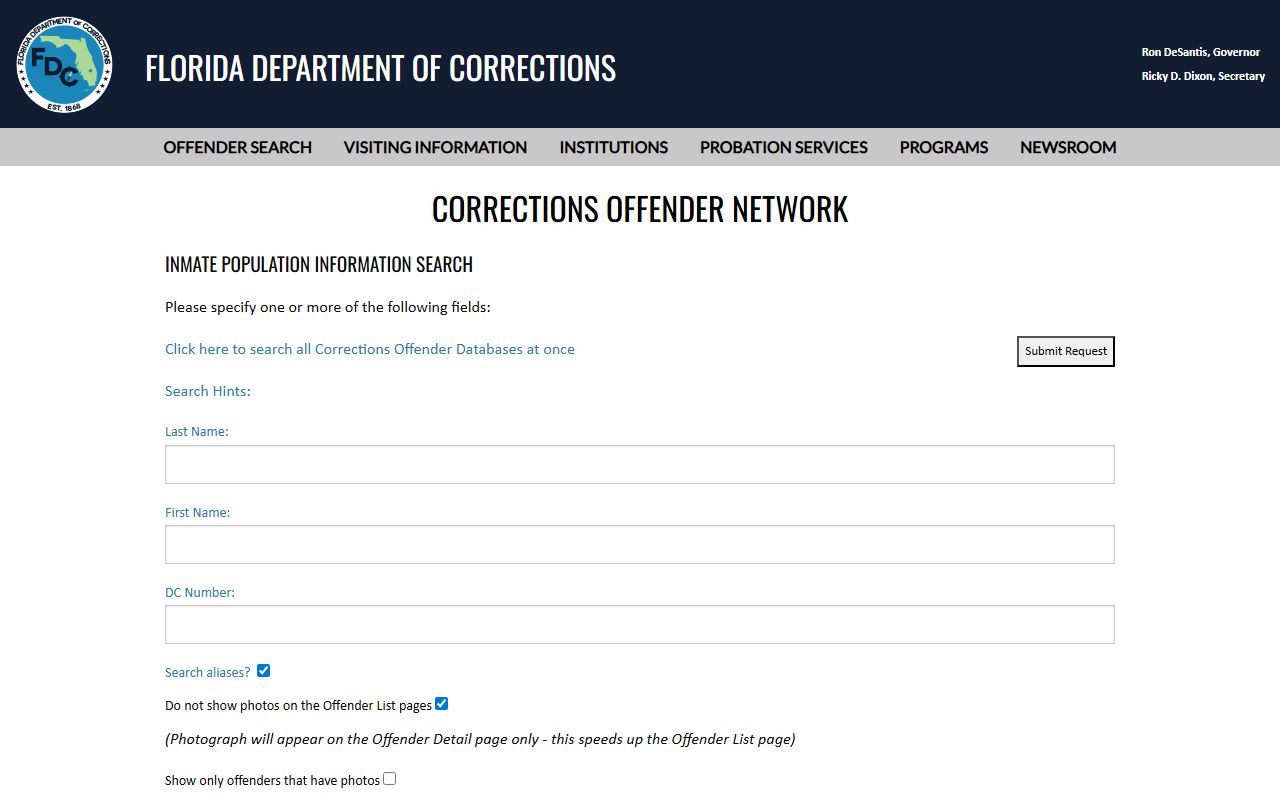
The state search is the right tool once someone leaves the county jail for a Florida prison, and full release tracking is covered on the released inmates page.
Release Notifications and Verification
If you need to know when someone leaves custody, you do not have to watch the roster every day. VINELink lets you register for custody and release notifications where the Florida agency feed supports it. You search by state and name, then sign up for alerts by phone or email. For official verification of a release, the Sheriff's Records Section can confirm status during its open hours.
The released inmates page covers VINELink, state release search, and federal locators in more detail. For a person you cannot find on the county roster, that page is the next step.
Visitation, Mail, and Commissary Rules
Visitation, mail, money deposits, and commissary are operational jail rules, not court records. The Sheriff sets them, and they can change. Schedules, vendors, pricing, and any lockdown rules are all controlled by the Sheriff's Office. For that reason, the current rules should always be confirmed on the official corrections page rather than from any outside source. Mail and money rules in particular should be followed exactly, because noncompliant mail or deposits can be rejected. Attorney visits are usually handled separately from social visitation.
We pull this lead-in from the Sheriff's official corrections page.
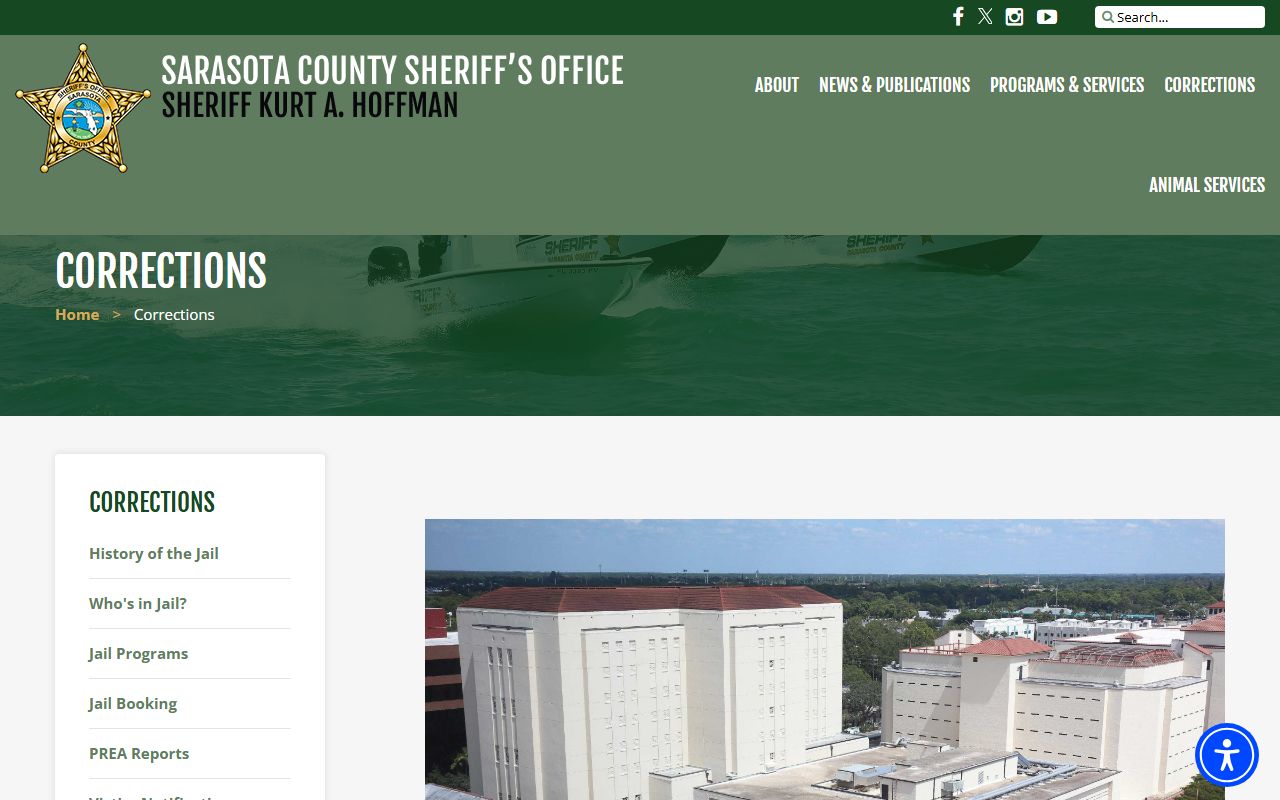
The corrections page is the authoritative source for visitation, mail, deposit, and commissary rules, since those details were not published in the other sources reviewed.
Requesting Sarasota County Sheriff Records
For an arrest report or other Sheriff record, the Sheriff's Office has a public records request process. Reports for arrests made by another agency should be requested from that arresting agency, since several agencies use the Sarasota County Jail. The Records Section can be reached at 941-861-4025 during open hours. We pull this lead-in from the Sheriff's official public records requests page.
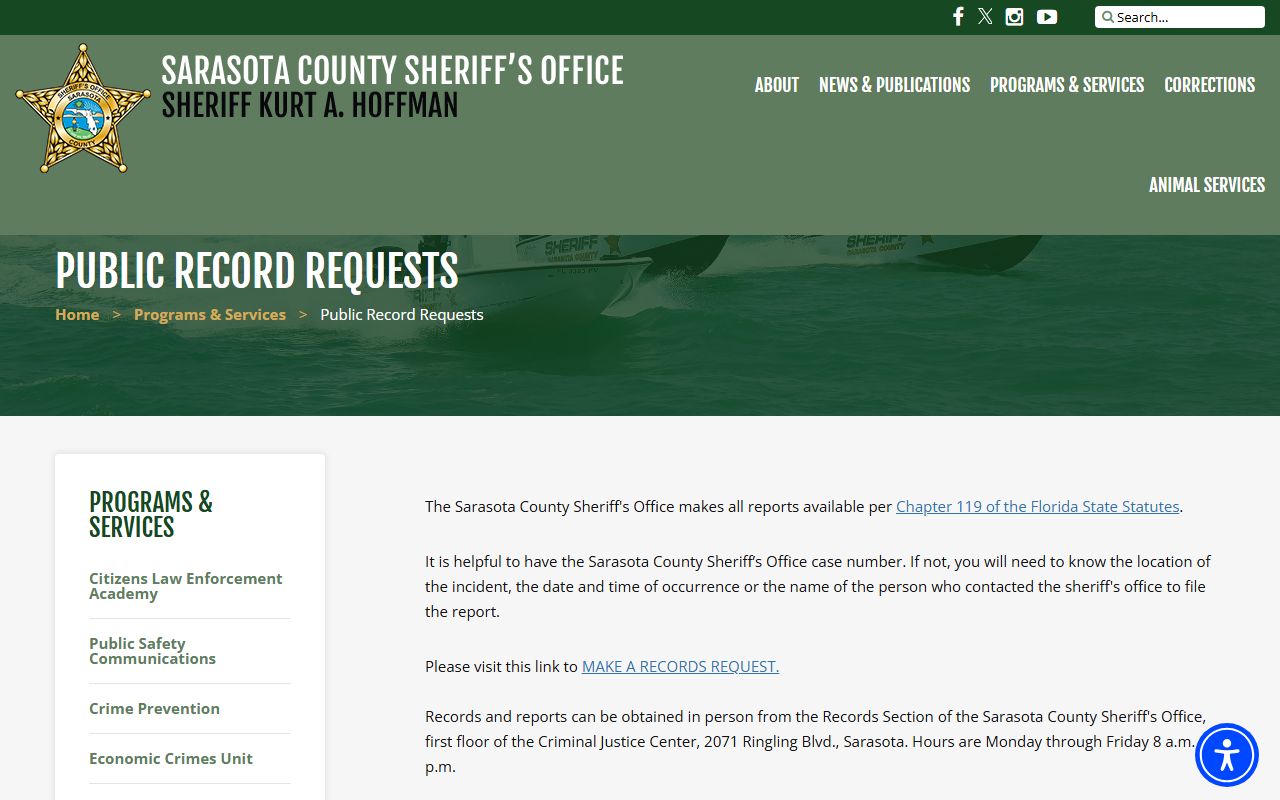
The request page routes inmate and arrest record requests to the right section, which keeps them separate from court files held by the Clerk.
Keep the two record systems straight when you ask for documents. The Sheriff holds arrest reports, booking data, and jail records. The Clerk holds the court case file. A request for an arrest report goes to the Sheriff or the arresting agency. A request for a charging document, plea, or judgment goes to the Clerk. Sending the request to the wrong office only slows things down. When in doubt, the Records Section can point you to the right place during its open hours.