
What Probate Covers in Sarasota County
Probate in Sarasota County is handled in the Probate Division of the Circuit Court. The division covers estates, wills, guardianships, trusts, incapacity proceedings, and mental-health-related court matters. When a person dies, the court oversees how the estate is settled, debts are paid, and assets pass to heirs. When a person cannot manage their own affairs, the court can set up a guardianship. Filings and record services run through the Sarasota Clerk of the Circuit Court and County Comptroller.
Florida law splits probate into several paths. Formal administration is the full process for larger estates. Summary administration is a shorter path for qualifying estates. Disposition without administration applies in limited cases. Guardianship is its own track, and ancillary administration covers a nonresident who dies owning Florida property. The Circuit Court hears all of these in its probate division, so a Sarasota County probate record is a circuit court record.
Most estate dockets are public. Sensitive parts are not. Medical, incapacity, and guardianship details may be confidential or redacted, even when the basic case information is open.
Sarasota County Probate Terms Defined
Probate uses words that do not come up in daily life. A quick guide helps when you read a Sarasota County probate file. The terms below appear often in estate and guardianship cases.
- Testator
- The person who made the will.
- Executor
- The person named to carry out the will; in Florida this role is the personal representative.
- Personal representative
- The person the court appoints to manage and settle the estate.
- Intestate
- Dying without a valid will, so state law decides who inherits.
- Guardianship
- A court arrangement where a guardian manages the affairs of a person who cannot do so alone.
How to Search Sarasota County Probate Records
Probate cases are searched in ClerkNet, the clerk's online court-record system. Use the free anonymous path for most lookups. Start at the ClerkNet login page and choose general public access. You can search by case number, by the name of the person who died, or by the name of a ward in a guardianship. The fields below reflect a probate search.
| Field | Type | Required | Notes / Format |
|---|---|---|---|
| Case Number | Text | Optional | Best for an exact probate case. |
| Decedent / Ward Name | Text | Optional | Name search for the estate or guardianship. |
| Case Type | Dropdown | Optional | Estate, guardianship, mental health, or trust where exposed. |
| Filing Date Range | Date | Optional | Narrows probate filings. |
| Search | Button | Yes | Runs the ClerkNet search. |
Quick steps to search:
- Open ClerkNet and read the access notice about confidential records.
- Choose general public access, then search by case number or name.
- Open a result to view the docket; note that many probate images are restricted online.
Will Deposit and Summary Administration in Sarasota County
Florida sets two rules that come up early in many estate cases. The first is the duty to deposit a will. Under Florida Statutes § 732.901, the custodian of a will must deposit it with the clerk of the court that has venue within 10 days after learning that the testator has died. This puts the will on file so the court can act on it.
The second is summary administration, a shorter probate path. Under Florida Statutes § 735.201, summary administration is available for qualifying estates, including estates below a statutory value or where the person has been dead for more than two years, subject to the statute's other requirements.
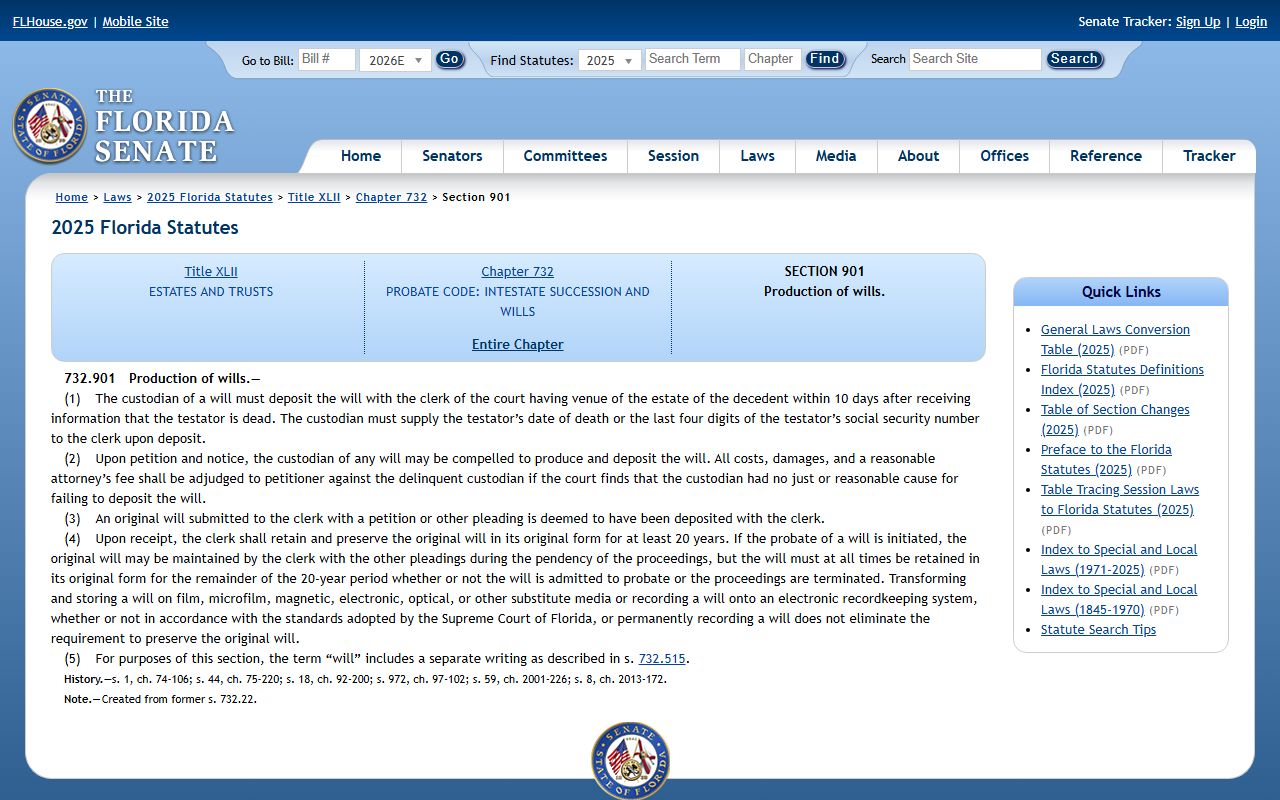
The will deposit statute is why many Sarasota County probate cases open soon after a death, when the custodian files the will with the clerk.
You can read the shorter-path rule on the summary administration statute page.
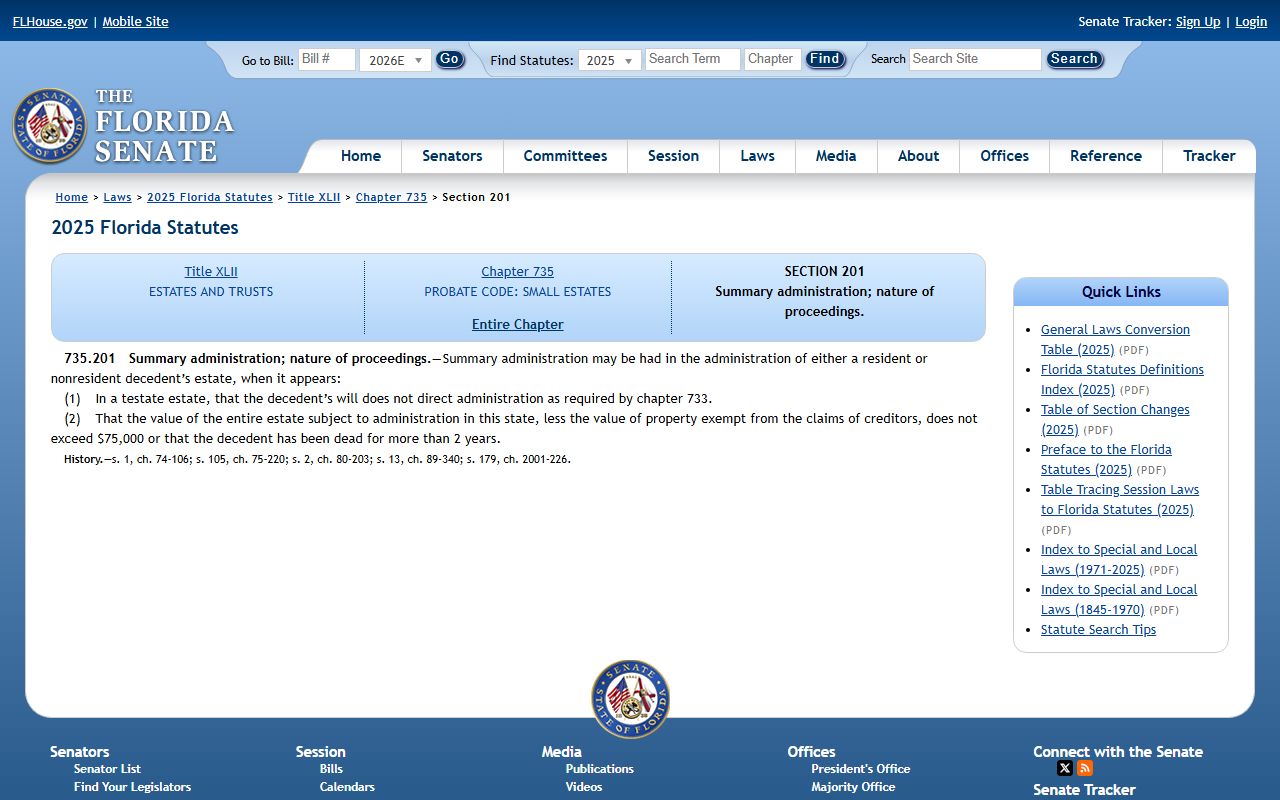
Summary administration can resolve a qualifying Sarasota County estate faster than formal administration, which is why many smaller estates use it.
What Sarasota County Probate Records Show
A probate file tracks the estate from opening to closing. The exact contents depend on the path and whether a guardianship is involved. Common parts include the petition, court orders, and the final discharge that closes the case. Guardianship files add plans and reports, many of which hold sensitive information.
- Petition - for administration or summary administration.
- Will and codicils - if filed and public.
- Appointment orders - admitting a will and appointing a personal representative, with letters of administration.
- Creditor notices and claims - debts filed against the estate.
- Inventory and accounting - estate assets and how they are handled, with some details restricted.
- Final discharge - the order closing the estate.
Note: Guardianship plans, medical reports, and incapacity findings are often confidential, so a docket may list them without showing the documents online.
The Sarasota County Probate Timeline
A probate case moves through set stages under court supervision. The exact path depends on the estate and whether a guardianship is involved, but most cases follow a clear order from opening to closing. Knowing the steps helps you read a docket and understand where a case stands.
- Confirm that venue is in Sarasota County.
- Deposit the will with the clerk if one exists.
- Choose the administration type with counsel or self-help guidance.
- File the petition and supporting documents.
- The court reviews eligibility, notices, and any objections.
- The personal representative or guardian receives authority if appointed.
- Assets, debts, notices, and distributions proceed under court oversight.
- The court closes the case with a final order or discharge.
Creditor claims, accountings, and distributions can stretch the timeline, so a formal estate may stay open for months. A summary administration moves faster because it skips many of these steps. The docket records each stage as it happens, so the case file is the clearest way to see where a Sarasota County probate case stands at any point in time.
Guardianship and Estate Records in Sarasota County
Probate is not only about wills. Guardianship is a major part of the division. A guardianship sets up a guardian to manage the affairs of a person who cannot do so, such as a minor or an adult found to lack capacity. These cases hold guardianship plans, accountings, and medical or incapacity reports. Many of those documents are confidential because they reveal private health and financial details.
Estate records, by contrast, show how a person's property is gathered, debts are paid, and assets pass to heirs. An intestate estate, where there is no will, follows Florida's order of inheritance. A testate estate follows the will. Both create a public docket, even when certain documents stay offline. The Sarasota Clerk maintains all of these probate records through the same court-record system used for other case types.
Sarasota County Probate Court Office
Probate filings and record services go through the Sarasota Clerk. The probate division itself is part of the Circuit Court and sits on the downtown court campus. The clerk's probate court page explains estate, guardianship, mental-health, and related filings. The contact card below points to the clerk's main office and probate resources.
Sarasota Clerk Probate Court Services
2000 Main Street
Sarasota, FL 34237
941-861-7400
Mon-Fri business hours
The clerk's probate court service page covers filing details, while the Probate Division of the Circuit Court hears the cases themselves.
Sarasota County Probate Filing Fees
Filing a probate case carries fees set by the county clerk and Florida law. Certified copies and other services have their own charges. Specific amounts were not confirmed for this page, so check the current schedule before you pay.
| Item | Amount |
|---|---|
| Probate or summary administration filing | See current Clerk fee schedule |
| Letters of administration | See current Clerk fee schedule |
| Certified copy per page | See current Clerk fee schedule |
| Guardianship filing | See current Clerk fee schedule |
For current amounts, see the Sarasota Clerk of the Circuit Court and County Comptroller site.
Restricted Sarasota County Probate Records
Probate cases often hold private details, so Florida limits online access to many images. Under Florida Statutes § 28.2221, subsection (5)(a), the general public has no remote access to images in cases governed by the Florida Probate Rules. The docket may be public while the documents stay offline.
Beyond that, medical records, incapacity findings, guardianship plans, and personal identifying information may be confidential or redacted. Sealed estates and certain mental-health proceedings carry tighter limits. To view a restricted document, you may need party status, authorized access, or a court order. The Clerk of Court can explain what is available and how to request it.